Switching Pools Without the Guesswork: A 139 TH/s Walkthrough
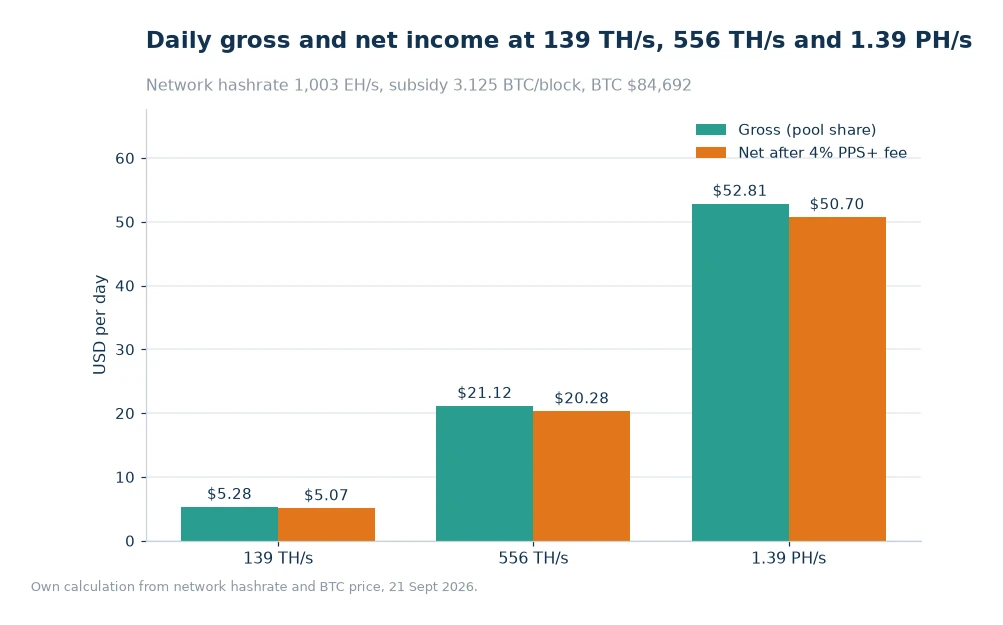
Moving a 139 TH/s rig to a new pool should change the dashboard, not the income. At the 21 September inputs that hashrate grosses $5.28 a day and nets $5.07 after the listed 4% on the block-reward component. This walkthrough covers the switch itself: what to measure before, what to watch during, and when to call the move finished.

Key takeaways
- 139 TH/s converts to 6.236e-05 BTC a day, worth $5.28 gross and $5.07 net at BTC $84,692.
- 556 TH/s earns $21.12 gross and $20.28 net; 1.39 PH/s earns $52.81 gross and $50.70 net.
- Keep the old pool running until the new dashboard shows a full 24 hours of credited shares.
- Point payouts at a multi-currency wallet under the same account so the first credit has somewhere to land.
Measure the old pool before touching anything
A switch without a baseline is superstition. For three days before the move, write down the old pool's daily credit in BTC, the reported hashrate, and the rejected-share rate. A 139 TH/s rig at current difficulty should hover near 0.00006236 BTC a day before fees, so if the old pool reports far less, the problem may be stale firmware or a flaky connection rather than the pool's brand. Numbers first, loyalty later.
While logging, note the payout rhythm too. Some pools settle hourly against difficulty, others wait for block confirmations, and the gap between the two can look like missing money during a transition. The chain itself issues 450 BTC a day across roughly 1,003 EH/s no matter whose logo sits on the dashboard, so any persistent shortfall against the formula belongs to configuration, uptime, or fees, in that order.
Point one worker at the new address
Migration day is deliberately boring. Create the sub-account, add a worker name you will recognise at midnight, and aim a single machine at the new stratum address while the rest keep hashing on the old pool. Within minutes the new pool status page should display live Pool Hashrate climbing and your worker among the shares. If the worker stays dark after ten minutes, the fault is almost always a typo in the address or port, not the network.
Give the trial worker a full day before judging income. Share accounting needs time to smooth out, and an hour-by-hour comparison will mislead because luck and difficulty windows chop the day into uneven pieces. After 24 hours, compare the credited BTC against the 0.00006236 BTC expectation for 139 TH/s. A result within a few percent, minus the listed rate, means the plumbing works and the rest of the fleet can follow.
What the fee line really costs a switcher
On the default PPS+ path the listed 4% applies to the PPS-settled block-reward slice, trimming the 139 TH/s gross from $5.28 to $5.07. The fee-bearing transaction slice runs under its own 2% PPLNS-style logic, so the two never merge into one headline deduction. Switching to ViaBTC Crypto Mining therefore trades about twenty-one cents a day for hourly settlement that pays against current difficulty without waiting on block luck.
The alternative PPLNS path lists 2% across the combined reward, which suits miners who stay pointed at one pool for long stretches and can ride out variance. A switcher testing the waters for a week will find the hourly path easier to reconcile, since each day's credit maps cleanly onto that day's difficulty. Pick the path that matches how long you intend to stay, not the one with the smaller printed number.
Where the first coins should land
Before moving the fleet, set the payout destination to a multi-currency wallet inside the same account, where deposits and pool earnings sit side by side. Pool-side mining payouts are zero-fee mining payouts, so nothing extra leaves the balance on the pool's side of the fence. From there Auto Conversion can swap between supported coins when the plan calls for it, without a separate exchange login at midnight.
Confirm the wallet address with a tiny test withdrawal before the full migration, the way electricians test a circuit before loading it. A one-line confirmation today prevents a support ticket later. While waiting, check that alerts and second-factor logins work on the new account; a pool move is also a security move, and fresh credentials deserve fresh protection.
| Fleet slice | BTC per day | USD gross | USD net |
|---|---|---|---|
| 139 TH/s, trial rig | 6.236e-05 | $5.28 | $5.07 |
| 556 TH/s, half fleet | 0.00024942 | $21.12 | $20.28 |
| 1.39 PH/s, full fleet | 0.00062356 | $52.81 | $50.70 |
The middle row is the recommended staging point: move half the fleet, run both pools for a day, and compare credited coins per terahash. If the new side matches the formula within its fee, finish the move. If it trails badly while the old side holds steady, the fault is in the new worker configuration, and half your income is still safe while you fix it.
Worked example
Rebuild every chart bar from the September chain inputs so the migration target is exact.
- Daily BTC per TH/s: 450 ÷ 1,003,000,000 = 0.00000044865 BTC.
- 139 TH/s: 139 × 0.00000044865 = 0.00006236 BTC, written 6.236e-05 BTC.
- Gross dollars: 0.00006236 × 84,692 = $5.28.
- Net: $5.28 × 0.96 = $5.07 after the listed 4% on the block-reward component.
- 556 TH/s is four times the trial rig: 0.00024942 BTC, $21.12 gross, $20.28 net.
- 1.39 PH/s is 1,390 TH/s: 1,390 × 0.00000044865 = 0.00062356 BTC, $52.81 gross, $50.70 net.
- Decision rule: migrate fully when the trial rig's 24-hour credit lands within a few percent of 0.00006236 BTC minus the listed rate.
Frequently asked questions
How long does a pool switch take?
Pointing workers takes minutes, but allow a full day of parallel running so the 139 TH/s trial rig can post close to 0.00006236 BTC before you move the rest.
Will my income drop during the move?
Only by the hours any rig spends offline between pools, since the chain still issues 450 BTC a day and each terahash keeps its proportional slice wherever it points.
Which settlement path suits a trial?
The default PPS+ path suits trials because its hourly credits map cleanly onto each day, while PPLNS pays after 6 confirmations and needs a longer window to judge fairly.
Stratum latency deserves a test most switchers skip. Ping the new pool address from the mining room and compare against the old one; anything under 100 milliseconds is fine for share submission, while consistently worse routes show up as stale shares within a day. Pick the server region the pool suggests for your continent rather than the default, then confirm the choice by watching the rejected-share rate across the trial day. Five minutes with a ping tool beats a month of vague underperformance.
Leave the old account open for a fortnight after the move. Straggler credits from the previous settlement window can still land days later, and an account closed in haste turns a small final payment into a support ticket. Export the old pool's history before anything expires, file it beside the new pool's first week, and only then delete the old workers. Clean migrations end with two complete records, not one record and a mystery.
Call the move done after one clean day
When the trial rig posts a full 24 hours within a whisker of expectation and the wallet shows the first zero-fee arrival, move the fleet, delete the old workers, and keep the old account open for a week in read-only watch. A careful switch costs one day of attention and buys months of certainty. Rush it, and every later shortfall will feel like the new pool's fault even when it is not.
Sources: pool status and wallet pages for hashrate display and payout destinations, plus the fee page for the listed 4% on the PPS-settled block reward and hourly PPS+ settlement; chain inputs read 21 Sept 2026 (network about 1,003 EH/s, difficulty 132.76 T, subsidy 3.125 BTC, 144 blocks a day, BTC $84,692); published 11 Nov 2026. Figures are arithmetic on those inputs[1].